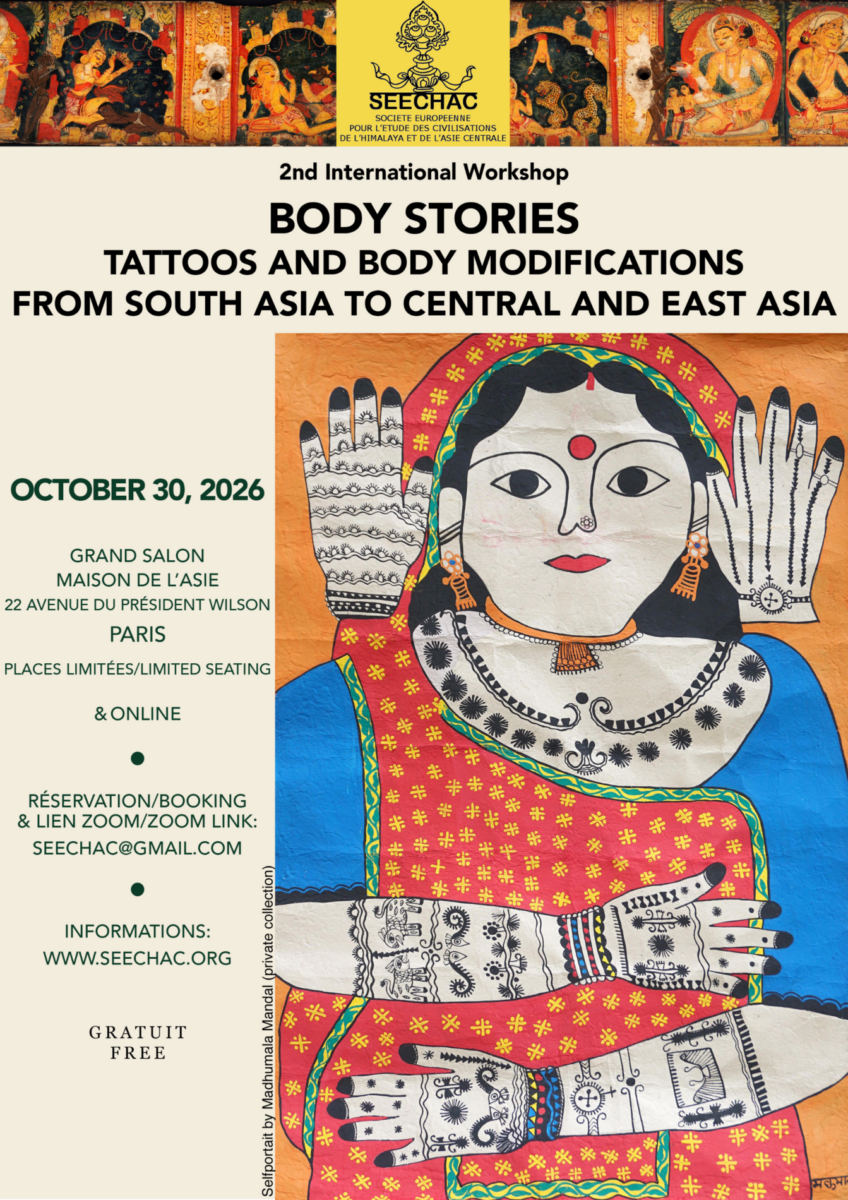
deuxième journée d’étude internationale de la SEECHAC qui se tiendra le 30 octobre 2026, à partir de 9H00, dans le grande salon de la Maison de l’Asie, 22 avenue du Président Wilson, 75016 PARIS.
Programme (sujet à modification)
| 8:30-9:00 | Arrival of participants (in Paris), connection of online participants |
| 9:00-9:15 | Opening remarks |
| Morning Session | Moderator: David C. Andolfatto | |
| 9:15-9:45
|
C. Upender Rao (Jawaharlal Nehru University, School of Sanskrit and Indic Studies, New Delhi, India)
Tattoos and Body Modifications in Ancient India: A Study of Sanskrit and Pāli Sources
|
| 9:45-10:15 | Raffaela Rettinger (University of Wuerzburg, Würzburg, Germany)
Brocaded Bodies and Street Ruffians: Decorative Tattooing Practices in Song Dynasty Urban Spaces and their Socio-Political Implications
|
| 10:15-10:45 | Kiraz Perinçek Karavit (Post-doctoral researcher, Turkey)
Horns or Masks? Rethinking Body Modification and Ritual Performance in the Mehmed Siyah Kalem Paintings
|
| 10:45-11:15 | Coffee break
|
| 11:15-11:45 | Karolina Kłoszewska (University of Warsaw, Faculty of Asian and African Cultures, Warsaw, Poland)
Hook Suspension and Ritual Piercing in the Cult of Māriyammaṉ: Body Modification as Devotion and Healing in Tamil South India
|
| 11:45-12:15 | Emily Shen
Li Women’s Facial Tattooing and the « Privatization of the Womb »: Body, Kinship, and Social Transformation in Hainan
|
| 12:15-12:45 | Nathalie Gauthard (Université Paris 8, laboratoire Scènes du Monde, Paris, France)
« Inked for Tibet » : le tatouage contemporain tibétain en exil entre performance artistique et désir de résistance
|
| 12:45-14:00 | Lunch |
| Afternoon Session | Moderator: Nathalie Gauthard | |
| 14:00-14:30 | David C. Andolfatto (Rubin Museum, New York, USA, and CRCAO, CREOPS, Paris, France)
An Overview of Vernacular Tattoo Traditions from Nepal and Presentation of the Himalayan Tattoo Initiative
|
| 14:30-15:00 | Naresh Shakya (Aksheswar Traditional Buddhist Art College, Lalitpur, Nepal)
Painting a Pair of Lions to Heal Herpes Zoster in Newāḥ Society |
| 15:00-15:30 | Charlotte Ramble (Newcastle University, Newcastle, UK)
Love, Timepass, and the Global Imaginary: Nepali Prisoners and their Tattoos
|
| 15:30-16:00 | Coffee break |
| 16:00-16:30 |
Brigitte Steinmann (Emeritus professor, CNRS Clersé, associate researcher CESAH, Lille and Paris, France)Desire to Love, Will to Win: When the Body Clothes the Mind. Designs and destinies of the Body among Nepali Migrant Workers |
| 16:30-17:00 | Dominic Steavu (University of California Santa Barbara, East Asian Languages and Cultural Studies, Santa Barbara, USA)
Ink, Needles, and Flesh: on the Possibility of Intersections between Ritual Sealing, Therapeutic Needling, and Apotropaic Tattooing in Medieval China—with References to Contemporary Japan
|
| 17:00-17:15 | Closing remarks |
Abstracts (by alphabetical order)
David C. Andolfatto (Rubin Museum, New York & CRCAO, CREOPS, Paris)
An Overview of Vernacular Tattoo Traditions from Nepal and Presentation of the Himalayan Tattoo Initiative
The vernacular tattoo traditions of Nepal have so far received remarkably little attention, from both academia and the public. Several factors may explain this neglect. One is a generational bias among Western scholars against tattooed individuals. Another lies in the fact that it is mostly women who bear these tattoos. The scarcity of ethnographic work on the topic may thus also stem from women rarely being the focus, or the primary informants, of past scholarship.
Internal factors within Nepal itself further account for this silence. The establishment of the « One King, One Dress, One Language » (Ek Rājā, Ek Bheṣ, Ek Bhāṣā) policy under King Mahendra in 1960 promoted a « normalisation » of Nepali culture. As tattooing was practiced mainly within indigenous communities such as the Jyāpu Newaḥ and Maithil, abandoning the practice came to be seen as a way of better fitting into this new, modern vision of Nepali identity. Younger generations of women largely stopped receiving traditional tattoos, with the younger generation favouring instead new iconographies and machine-made ink.
This presentation offers a partial overview of vernacular tattoo traditions across Nepal, and introduces the Himalayan Tattoo Initiative, a project I launched in 2024 to collectively document these tattoo traditions and the stories behind these rich body markings.
Nathalie Gauthard (Université Paris 8, laboratoire Scènes du Monde, Paris, France)
« Inked for Tibet » : le tatouage contemporain tibétain en exil entre performance artistique et désir de résistance.
Août 2025, Loten Namling, un musicien tibétain de l’exil vient à Paris se faire tatouer 159 flammes, symbolisant les 159 Tibétains décédés par immolation. La séance est diffusée en streaming sur Facebook, entrecoupée de discours politique, de chants, de performances musicales, récitation des poèmes de Milarepa et entretien avec des journalistes tibétains[1]. Le 13 août dernier, le Tibetan Youth Congress (TYC) – en réaction à l’immolation du militant Logba Rangzen – lance une campagne de tatouage gratuit à Dharamshala. L’objectif est de rendre visible sur son corps la « cause tibétaine ».[2]
La pratique du tatouage au sein des communautés tibétaines exilées n’est pas nouvelle. Elle se propage, en même temps que la mode des tatouages à partir du début des années 2000 et il n’est pas rare de croiser des Tibétains avec les inscriptions « Tibet Libre » ou le mot « espoir » en tibétain tatouées sur les bras ou des mantras bouddhistes.
L’usage du tatouage artistique comme forme d’action politique, de résistance culturelle ou de mobilisation diasporique a plusieurs fonctions simultanées : rendre visible la cause tibétaine ; produire une cohésion diasporique ; agir diplomatiquement (par ex. un sportif arborant fièrement le mot Tibet durant une compétition) ; ou contourner certaines formes de censure ou de marginalisation.
Ma communication portera sur trois études de cas : le tatouage comme performance artistique (Loten Namling », comme résistance politique (TYC) et réinvention religieuse (Tashi Norbu).
Kiraz Perinçek Karavit (Post-doctoral researcher, Turkey)
Horns or Masks? Rethinking Body Modification and Ritual Performance in the Mehmed Siyah Kalem Paintings
The enigmatic works known as the Mehmed Siyah Kalem paintings, preserved in two albums at the Topkapı Palace Museum Library in Istanbul, depict a world of nomadic life and fantastical creatures. The materials and artistic style suggest a 14th-century production environment at the crossroads of Chinese and Central Asian Turkic cultural realms. While often assumed to illustrate recitations, their original context is lost. Scholarly attention has persistently focused on their unique theme: demons. These figures feature prominent body modifications, including horns, tails, and chains around necks and wrists, yet they are puzzlingly depicted interacting with humans in everyday activities like drinking, dancing, or woodcutting.
This presentation challenges the “demon” interpretation by examining these depictions as human ritual performers. A critical piece of evidence is the “wrestling illustration” (jiaoditu 角觝 圖) from the Chinese encyclopedia Sancai Tuhui (三才圖會, 1607). This source reveals a ritual activity where contestants dance while bearing animal masks with horns—a practice directly reflected in the Chinese term for wrestling, jiaodi 角觝, literally meaning “horn resistance.” The figures are thus re-interpreted as human contestants aspiring to animal powers through body modifications, as exactly observed in the Chinese textual and visual sources like dynastic histories or Dunhuang mural paintings.
This paper uses a comparative analysis to argue that the paintings document a performative tradition from Central and East Asia. It demonstrates how temporary body modifications functioned not as markers of the demonic, but as instruments of ritual transformation, allowing humans to embody animal power in one of the world’s most ancient sports.
Karolina Kłoszewska (University of Warsaw, Faculty of Asian and African Cultures, Warsaw, Poland)
Hook Suspension and Ritual Piercing in the Cult of Māriyammaṉ: Body Modification as Devotion and Healing in Tamil South India
In South Asia, human bodies are often transformed into mediums between humans and the sacred during rituals. In the worship of Māriyammaṉ, a Tamil goddess associated with illness, healing, fertility, and protection, body modification embodies tangled relations between devotion, suffering, and divine exchange. This paper explores two types of ritual body modification practiced during Māriyammaṉ festivals: ceṭil (hook suspension) and ālaku (ritual piercing of the cheeks or tongue). These customs, prevalent in Tamil village goddess traditions, are performed as expressions of devotion and as vow fulfilments (nērtikkaṭaṉ), during which devotees seek protection, and divine intervention. In ceṭil, hooks are placed into the skin along the back, and the participant is either lifted or drawn in procession, transforming the body into a ritual offering. Instead of depicting self-induced suffering in isolation, the act serves as an embodied exchange with the goddess, where physical endurance reflects religious purpose. Ālaku piercing, often associated with possession (āvēcam/cāmiyāṭṭam), also turns the body into a symbol of faith and divine involvement. By situating these practices within the larger context of Tamil goddess worship, and drawing on ethnographic studies, Tamil devotional literature, and temple rituals, the paper examines how bodily alteration, endurance, and recovery interweave in ritual performance. It argues that hook suspension and ritual piercing should be understood not simply as spectacular forms of bodily transformation but as religious practices through which worshippers negotiate disease, vulnerability, self-identity, and their bond with Māriyammaṉ.
Charlotte Ramble (Newcastle University, Newcastle, UK)
Love, timepass, and the global imaginary: Nepali prisoners and their tattoos
Prison tattoos are well documented as markers of belonging to gangs or recording criminal and personal history, with the more infamous ones including Russia, South Africa and El Salvador. This paper considers tattoos in a very different setting: a rural district prison in Nepal’s Karnali Province, drawing on 18 months of ethnographic fieldwork on everyday life inside. With no history of organised prison gangs in Nepal in the same way as the countries listed above, the tattoos I discuss follow no fixed iconography. Instead, hand-poked tattoos of names, initials, and hearts, done in the dormitories to fill the long hours, are often tributes to wives, girlfriends, children, and mothers. Alongside choices of clothing, hairstyles, how men personalise their dormitories and the television programmes they watch, tattoos of tribal designs, dragons, or gods, become part of a way of engaging with a global imaginary shaped by popular culture from Nepal and abroad. For some, paradoxically, confinement offers access to this global imaginary in ways unavailable in the rural villages they come from. The quality of a tattoo is also revealing, as machine tattoos are only available in larger, urban prisons, or indicate that someone lived in a city before imprisonment, whereas in more rural facilities only hand-poked tattoos are possible. Read within the broader material culture and sociality of men in prison, these tattoos become testaments to the absence of families, and to the bonds formed among young men.
Upender Rao (Jawaharlal Nehru University, School of Sanskrit and Indic Studies, New Delhi, India)
Tattoos and Body Modifications in Ancient India: A Study of Sanskrit and Pāli Sources
Tattoos and body modifications constitute an important yet understudied aspect of ancient India’s cultural history. The ancient Indian textual traditions preserve rich information on bodily markings and ornamentation. This paper examines references to tattoos and body modifications in Sanskrit and Pāli literature, with particular attention to the epics, the Purāṇas, the Suśruta Saṃhitā, the Caraka Saṃhitā, Buddhist Pāli canonical texts, and commentaries. These sources reveal that body modification was associated with religious observances, rites of passage, social identity, gender, ascetic practices, medical procedures, and aesthetic ideals.
The study explores the terminology employed for bodily markings and modifications, distinguishing permanent tattoos from cosmetic painting and other forms of bodily adornment. In ancient Indian classical literature, bodily appearance and ornamentation are discussed within broader ethical, monastic, and social contexts, providing valuable insights into everyday life and cultural practices. Archaeological and iconographic evidence is considered only to supplement the literary record and to corroborate the continuity of these traditions.
By integrating Sanskrit and Pāli textual sources with available archaeological data, this paper argues that tattoos and body modifications were not merely decorative practices but significant expressions of identity, religious affiliation, social status, therapeutic knowledge, and cultural symbolism. The study highlights the importance of classical Indian literature for reconstructing the history of body modification and contributes to broader discussions on embodiment, material culture, and the social history of ancient South Asia.
Raffaela Rettinger (University of Wuerzburg, Würzburg, Germany)
Brocaded Bodies and Street Ruffians: Decorative Tattooing Practices in Song Dynasty Urban Spaces and their Socio-Political Implications
Since its earliest records, tattooing in premodern China has been categorized as foreign, immoral and used to mark criminals, servants, and soldiers. However, despite this persisting stigma against inked skin, a voluntary, decorative tattooing subculture began to emerge during the Tang (618–907) and came into full bloom during the Song dynasty (960–1279).
Described as the “golden age of tattooing” by Japanese scholar Sogabe Shizuo, the Song dynasty was the first to institutionalize penal and military tattooing. It is against this backdrop that men in urban and military spaces began to engage decorative tattooing. One group known as the Brocaded-Body Society even performed during grand celebrations, highlighting the visibility of alternative tattooing customs as well as a fascination with inked bodies. Surrounding this subculture, a market of tattoo specialists formed that could offer diverse designs of varying qualities, sizes, and prices. Even high-ranking officials are recorded as frequenting these masters to have their bodies tattooed.
The case of an urban decorative tattooing subculture calls into question the prevailing stereotype of the “tattooed ruffians of the market streets” and lays bare a far more complex socio-political developments of everyday life. By focusing on the interplay between alienation and appropriation, this paper shines a light on those men, who used ink as medium and their bodies as canvas to connect with or criticize other members of society and thus find their place in Song urban culture.
Naresh Shakya (Aksheswar Traditional Buddhist Art College, Lalitpur, Nepal)
Painting a Pair of Lions to Heal Herpes Zoster in Newāḥ Society
Art of painting in its various forms is an integral part of the cultural heritage of Newāḥ community in the Kathmandu valley. Buddhist painting is one of the predominant art forms in Nepal, and Newāḥ artists have introduced this artistic tradition across the Himalayan regions and as far as China and Mongolia. One of the most unique traditions of Newāḥ society is the painting of a pair of lions (the mystical siṃha) to treat Herpes Zoster. Herpes Zoster, known as Janai Kai in Newāḥ language, is a very common illness among the Newāḥ community. The word “Janai” means a “Sash” (a strip of cloth tied around the waist), while “Kai” means a skin ailment. Because this infection commonly occurs around the waistline, it is known by this name. The most common traditional remedy is the painting of a pair of lions. The color combination used in the painting is believed to have medicinal properties. The paint consists of two parts white lime, one part red cinnabar, and one part black pigment made from the soot of nine herbs. These are the principal ingredients used in painting the lions. They are painted by Pūṃ (Chitrakāra or traditional painters) and this tradition continues to be practiced in Newāḥ society, even though significant advances have been made in the field of medicine.
Emily Shen
Li Women’s Facial Tattooing and the « Privatization of the Womb »: Body, Kinship, and Social Transformation in Hainan
Li women’s facial tattooing in Hainan has a history spanning several millennia and represents one of the most significant surviving traditions of female tattooing in East Asia. Unlike many tattoo traditions associated with male warfare, headhunting, or patriarchal authority, Li women’s facial tattooing has long been closely connected with female initiation, marriage eligibility, ethnic identity, ancestor veneration, and the transmission of cultural memory. Rather than serving as ornamentation alone, facial tattooing functioned as a bodily inscription that marked major transitions in a woman’s life.
Previous scholarship has primarily interpreted Li facial tattooing as a rite of passage, an ethnic marker, or an aesthetic practice. This paper proposes a different analytical perspective. I introduce the concept of the « Privatization of the Womb » not as an established historical fact, but as an analytical framework for examining how women’s reproductive capacity became increasingly regulated through changing marriage systems, patrilineal kinship, inheritance practices, and state governance.
Drawing on twelve years of ethnographic fieldwork among Li women in Hainan, I argue that facial tattooing was not only a marker of female adulthood and reproductive status, but also embodied women’s identity, ancestral memory, and cultural continuity. As Han cultural influence expanded and systems of marriage, kinship, and modern state administration were progressively transformed, the social meanings attached to women’s bodies also changed. Within this historical context, the practice of facial tattooing gradually disappeared during the mid-twentieth century.
Dominic Steavu (University of California Santa Barbara, East Asian Languages and Cultural Studies, Santa Barbara, USA)
Ink, Needles, and Flesh: On the Possibility of Intersections between Ritual Sealing, Therapeutic Needling, and Apotropaic Tattooing in Medieval China—with References to Contemporary Japan
This paper examines the “sealing” (yin 印) methods of medieval Daoism and Buddhism as therapeutic practices in China. Among other aspects, it scrutinizes their technical dimension, focusing on the acquired and embodied know-how of the healer in drawing or impressing powerful therapeutic symbols. This is not unlike the practice of needling or acupuncture, in the context of which physicians deployed therapies via very precise and technically complex gestures. In lesser-known practices, physicians also employed ritual methods involving the application of healing symbols on the body, much akin to their Daoist and Buddhist counterparts. To what extent was the world of ritual sealing imbricated with that of medicine? And could both of these have been related to the emerging practice of tattooing (wenshen 紋身) in the Tang dynasty, another craft that employed “sealing » techniques and needle/lancet-manipulation towards sometimes therapeutic ends? Can the traditional Japanese shisei 刺青 tradition, which represents the most direct heir to medieval Chinese tattooing, offer any clues? The paper will attempt to provide preliminary answers to these key questions.
Brigitte Steinmann (Emeritus professor, CNRS Clersé, associate researcher CESAH, Lille and Paris, France)
Desire to Love, Will to Win: When the Body Clothes the Mind. Designs and Destinies of the Body among Nepali Migrant Workers
They are twenty, born in Nepal in the twenty-first century: the harsh law of Hindu castes and ‘raison d’état’ have bowed their heads under burdens, broken their backs, and condemned their forebears to walk under the yoke. They are between 13 and 17, and left of their own accord or were sold through prostitution networks. Foreigners, or close relatives, dangled before them implausible riches and fabulous horizons. They emigrated on long odysseys, and the luckiest reached the longed-for shores. Many disillusions have marked their flesh and muscles; trials have left invisible traces. These have been transmuted into tattoos, into more or less permanent marks—of nostalgia, hope, or triumph—displayed on their bodies, openly or as hidden signs.
We begin from several axioms, hypotheses, and examples to illustrate, compare, and explain the forms of tattoos and bodily transformations chosen by these Nepali migrant workers in Europe and Asia. We seek to establish typologies of tattoos and bodily modifications according to occupations and “body trades”: services, sex work, and the Foreign Legion in Europe and Asia.
Our first hypothesis is rooted in the general phenomenology of emotions and the idea that the body, as “flesh,” is an eminently emotional material; the second situates the inquiry within political and social class relations shaping labour migration and how these may orient design choices; the third, aesthetic in nature, concerns what might be called “spiritual contamination,” emulation, and imitation, signalling desires for social ascent and success.
The examples derive from many years of anthropological fieldwork, both in migrants’ countries of departure and in their countries of arrival. We aim to draw up a reasoned typology of motifs and bodily transformations associated with the singular and collective destinies of those selected in the study, alongside other already documented cases.
[1] Voir ma conférence en ligne dont une partie porte sur Loten Namling et sa performance : Diasporas tibétaines en scènes : entre artivisme, tradition et hybridité, SFEMT, avril 2026.
[2] https://phayul.com/inked-for-tibet-tibetans-turn-their-skin-into-canvas-of-resistance/